
Building Management System for Hotels in Nigeria: Why Energy Costs Are Being Ignored
Ask any hotel GM in Lagos what their biggest cost headache is, and you’ll hear the same answers: labour costs, food and beverage margins, OTA commission rates. What rarely makes the list but consistently ranks as the single largest controllable operational expense is energy.
In a typical Nigerian hotel without intelligent building controls, energy accounts for 20–30% of total operating costs. In properties relying heavily on diesel generation during grid outages, that figure climbs significantly higher. Most of this cost is invisible, untracked, and unmanaged.
What “Unmanaged” Means in Practice
Consider a 200-room hotel in Victoria Island. On a Tuesday afternoon with 60% occupancy:
- Air conditioning is running full-blast in 80 unoccupied rooms
- Corridor lighting on three floors is operating at full intensity with no occupants.
- The chiller plant is meeting a load that hasn’t been optimised since installation.
- The engineering team doesn’t know the above is happening because there’s no system to tell them.
This is not mismanagement. It’s the natural state of a building without automation. The only solution is intelligence.
Why This Problem Persists Across Nigerian Hotels
Most hotels rely on:
- Manual monitoring
- Static schedules
- Reactive maintenance
These approaches fail because:
- Energy usage is dynamic, not fixed.
- Occupancy fluctuates hourly.
- Equipment performance degrades over time.
Without intelligence, optimisation is impossible.
What BMS Changes for Hotel Operations
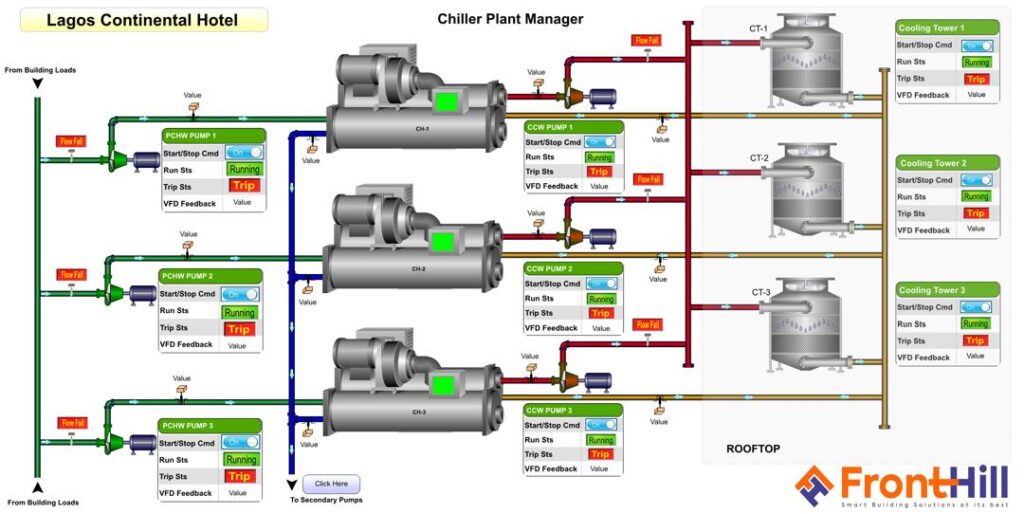
A hotel BMS provides centralised visibility and control across all major systems in the building.
For hotels specifically, this means
- HVAC automatically reduces cooling in unoccupied rooms.
- Corridor and common area lighting adjust based on occupancy.
- The chiller plant is optimised based on actual load.
- Real-time monitoring of energy consumption by floor, department, system, or zone.
- Real-time alerts and diagnostics that identify inefficiencies before they escalate into cost.
The operational shift is immediate and measurable.
The ROI Calculation Is Straightforward
For a 200-room hotel at current Lagos energy costs, a 25% reduction in energy consumption typically represents savings of ₦10–18 million per month. Against a BMS capital investment that typically amortises over 3–5 years, the financial case is clear.
Beyond Savings: Additional Benefits of a Building Management System for Hotels in Nigeria
A BMS delivers more than cost reduction:
Extended Equipment Lifespan
Optimised operation reduces wear on chillers, AHUs, and other critical assets.
Lower Maintenance Costs
Predictive insights reduce breakdowns and emergency repairs.
Improved Guest Experience
Consistent temperature control and comfort directly impact:
- Guest satisfaction scores
- Online reviews
- Repeat bookings
Why Most Hotels Delay BMS Adoption
Despite clear ROI, adoption is often delayed due to:
- Perceived high upfront cost
- Lack of technical understanding
- Underestimation of energy losses
However, the real cost is not implementation. It is continued inefficiency.
According to the International Energy Agency, improving building efficiency is one of the fastest ways to reduce operational costs in commercial facilities.
Energy in hospitality should not be treated as a fixed expense.
It is:
- A controllable cost
- A measurable performance metric
- A direct lever for profitability
Hotels that adopt intelligent systems gain a structural advantage in:
- Cost control
- Operational efficiency
- Competitive positioning
Most hotels are not losing money because energy is expensive. They are losing money because energy is unmanaged.
What does your hotel’s energy waste actually cost you?
Fronthill Controls can model:
- Your current energy inefficiencies
- Projected savings with a BMS
- ROI timeline specific to your property
- Deploy a tailored BMS solution
Want to see what a hotel BMS ROI calculation looks like for your specific property?
Request Your Free BMS ROI Assessment