
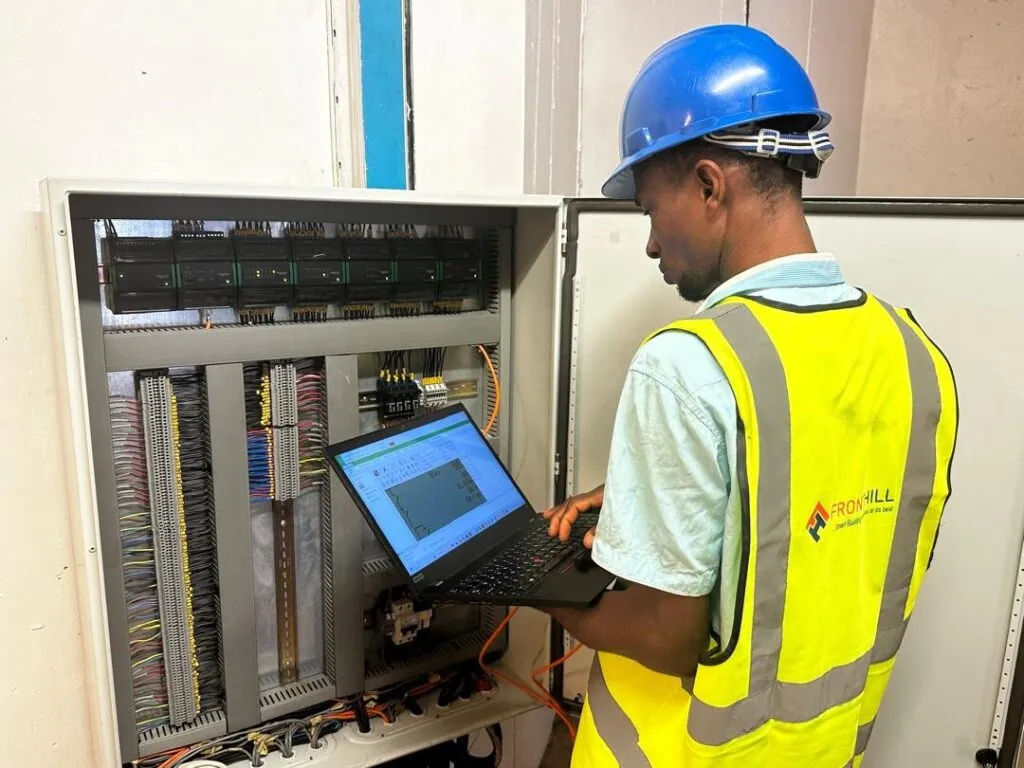

Building Management System Nigeria adoption is accelerating as commercial buildings face rising energy costs and operational inefficiencies. In cities like Lagos, facility managers are turning to intelligent automation to reduce waste, improve system performance, and achieve measurable energy savings.
What is a Building Management System (BMS)?
A Building Management System in Nigeria is one of the most effective solutions for reducing energy consumption, improving efficiency, and gaining full control over building operations.
Commercial buildings that deploy a BMS correctly achieve 20–35% energy savings, often within the first month.
How does a Building Management System (BMS) Save Energy?
A building management system (BMS) saves energy in commercial buildings by connecting every major mechanical and electrical system, HVAC, lighting, power, fire safety, and access control under a single intelligent control platform.
Instead of each system operating independently and wastefully, the BMS coordinates them in real time based on occupancy, load, time of day, and external conditions.
In short: A BMS eliminates energy waste by automating building systems to run at exactly the right level for actual conditions, never more, never less. It is the difference between a building that reacts to what is happening and one that runs on a fixed schedule, regardless of reality.
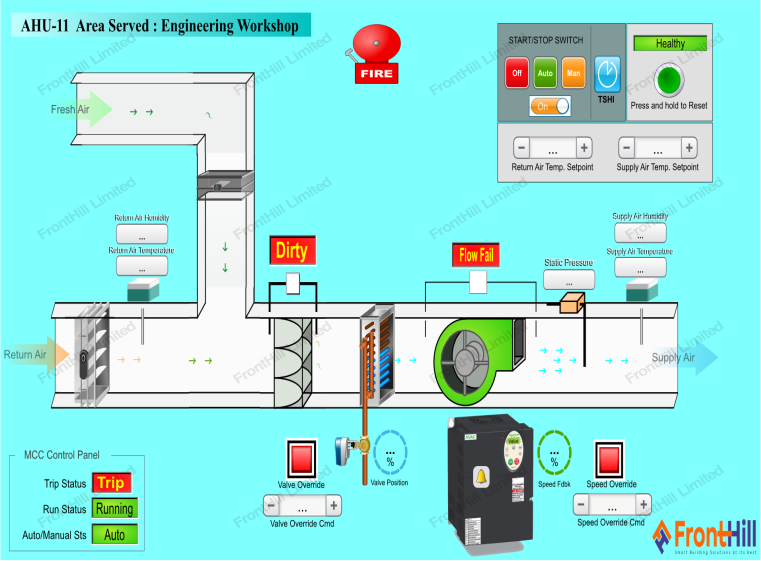
Here’s exactly how a BMS reduces energy consumption in commercial buildings — and what kind of savings to realistically expect.
HVAC Optimisation: The Largest Source of Energy Savings
Heating, ventilation, and air conditioning accounts for 40–60% of a commercial building’s total energy use in Nigeria. Our Building Management System solution controls HVAC equipment based on real-time occupancy data, internal temperature sensors, and external weather conditions.
Instead of running chillers and air handling units at full capacity from 6 am to 10 pm regardless of how many people are in the building, the BMS modulates output continuously to match actual demand. On a day when the building is 40% occupied, the HVAC system runs at 40–50% capacity, not 100%. The resulting HVAC energy savings are typically 20–35%.
Intelligent Lighting Control
Integrated lighting control through a BMS links lights to occupancy sensors, daylight harvesting sensors, and time schedules. If the office floors are empty at 7 pm, the system dims and switches off automatically. For large commercial office blocks, BMS-integrated lighting control reduces lighting energy consumption by 30–50% compared to manually operated systems.
Equipment Scheduling and Energy Waste Elimination
Every piece of plant equipment, chillers, pumps, boilers, air handling units has an energy-optimal operating window. A building management system programs start/stop schedules for all major equipment, ensuring nothing runs outside of required operating hours.
For a commercial office building, this means the chilled water system starts 30 minutes before occupancy, ramps down during the lunch period when loads are lower, and shuts down 30 minutes after the last occupant leaves. The standby and overnight energy waste that previously ran unnoticed is eliminated.
For a data centre or hospital with 24/7 operations, the BMS ensures that equipment serving lower-demand periods runs at reduced capacity rather than full load.
Fault Detection and Predictive Maintenance
A BMS continuously monitors system performance and flags anomalies. A chiller running 15% less efficiently than its baseline, a pump drawing abnormal current, or an air handling unit operating outside its setpoints — all of these are caught and reported before they become expensive failures. Addressing faults early keeps energy consumption at baseline and avoids emergency repair costs.
Real-Time Energy Monitoring and Reporting
One of the most underappreciated energy benefits of a BMS is the data it generates. Facility managers gain access to granular reports on energy consumption by floor, system, time of day, and occupancy level. This visibility makes it possible to identify waste, track the impact of operational changes, and build a case for further investment in efficiency upgrades.
Buildings that actively use BMS reporting data consistently outperform those that install the technology but do not engage with the analytics. The data also supports LEED and EDGE certification submissions, ISO 50001 audits, and ESG reporting requirements for institutional investors.
How Much Energy Can a BMS Save?
Based on BMS projects delivered by Fronthill Controls across Nigeria and Sub-Saharan Africa, commercial buildings with a properly configured and actively managed BMS achieve:
| Area | Typical BMS energy saving |
| Overall energy consumption | 20–35% reduction |
| Lighting energy use | 30–50% reduction |
| Generator fuel consumption | 15–25% reduction |
| Typical payback period | 2–4 years |
Note: Actual savings depend on baseline building performance, systems integrated, and how actively BMS data is used by facility management.
Cost of Building Management System in Nigeria
The cost of a Building Management System in Nigeria varies depending on:
- Building size (sqm)
- Number of systems integrated
- Existing infrastructure
- Level of automation required
While initial investment varies, most buildings achieve: Full ROI within 2–4 years through energy savings
ROI Insight:
Most buildings recover investment within 2–4 years through energy savings
Benefits of a Building Management System in Nigeria for Commercial Buildings
A Building Management System in Nigeria delivers:
- Reduced energy costs
- Improved occupant comfort
- Increased equipment lifespan
- Better operational control
- Data-driven decision making
For commercial buildings, this directly translates into higher profitability.
Is a Building Management System(BMS) suitable for your building?
A BMS is ideal for:
- Commercial office buildings
- Hotels
- Hospitals
- Data centres
- Industrial facilities
It is especially effective for buildings:
- Running multiple integrated systems
- Above 1,000 sqm
- With high energy consumption
Fronthill Controls designs, deploys, and maintains building management systems for commercial buildings across Nigeria.
Get in touch with us for a free energy assessment and find out how much your building could save.
Frequently asked questions
How quickly does a BMS start saving energy?
Energy savings begin from the first day of full BMS operation. Most commercial buildings in Nigeria see measurable reductions in their first monthly energy report. Full optimisation — including tuning of schedules, setpoints, and demand management thresholds — typically takes 3–6 months.
Does a BMS work with existing building systems?
Yes. A BMS integrates with most existing HVAC, lighting, and electrical systems through open protocols including BACnet, Modbus, and KNX. Fronthill Controls carries out a full system audit before any BMS design to confirm compatibility and identify any equipment that requires upgrading.
What is the difference between a BMS and an EMS?
A BMS (building management system) is a broad platform controlling all building systems. An EMS (energy management system) is specifically focused on energy monitoring, reporting, and optimisation — often used in hotels and manufacturing. In practice, modern BMS platforms incorporate full EMS functionality.
Can a BMS help with LEED or EDGE certification in Nigeria?
Yes. A BMS generates the metering data, energy reports, and performance evidence required for both LEED and EDGE certification. It also demonstrates ongoing commitment to energy performance, a requirement for LEED O+M (existing buildings) recertification.
Get a Building Management System in Nigeria
If your building has high energy costs, a Building Management System in Nigeria is the most effective solution.
Fronthill Controls delivers BMS solutions for commercial buildings across Nigeria.
CTA:
Request a free energy assessment today and discover your potential savings.